Quantum Braid Dynamics:
A Computational Process
This interactive atlas introduces the mechanics of a background-independent cosmos. Discover a framework where local network rewrites act as universal quantum gates, the vacuum executes a self-repairing stabilizer code, and gravity emerges naturally as the entropic drag of information processing.
Search for the Primitive
A millennia-long historical trace of the ultimate physical primitive. Quantum Braid Dynamics anchors its pre-geometric poset ontology in the classical debates of continuous fields and discrete particles, showing that modern computational geometry is the natural synthesis of these historical streams.
Traces the debate of Being versus Becoming, showing how Democritus resolved Parmenides Eleatic block by introducing the physical reality of the Void.
Examines Mohist and Daoist physics in ancient China, reinterpreting Qi and Ganying (sympathetic resonance) as precursors to wave fields and action-at-a-distance.
Reviews Ibn al-Haytham's experimental method and Avicenna's theory of Mayl (internal inclination), marking the evolution of projectile dynamics.
Details Jean Buridan's refinement of Mayl into Impetus, establishing that motion is a state conserved within the body rather than a force constantly applied.
📖 Key Chapter Definitions
Takeaways for Specialists
Substrate
Quantum Braid Dynamics attempts a rigorous derivation of spacetime from a pre-geometric, information-theoretic substrate. Rather than treating graph rewriting as a purely generative algorithmic exercise, it anchors its mechanics in formal logic, constructor theory, and causal finitism.
Avoids dogmatic foundationalism by introducing a coherentist epistemology, framing physical postulates as a self-consistent network of relational facts verified by macroscopic stability.
Establishes graph-theoretic definitions for fundamental pre-geometric structures, distinguishing between open transitive paths and closed cyclic geometric quanta.
Decouples system evolution into two orthogonal temporal axes: discrete Global Logical Time () and emergent continuous Physical Time () derived from geodesic path lengths.
Formalizes the pre-geometric substrate as a dynamic poset where vertices represent pure relational events and history is preserved via monotonic Lamport timestamps.
Restricts kinematics to a minimalist constructor-theoretic repertoire of edge addition and deletion, preserving microscopic reversibility.
📖 Key Chapter Definitions
Takeaways for Specialists
Constraints
Establishes strict topological consistency rules, enforcing irreflexivity, acyclicity, and locally finite boundaries on logical event updates to prevent temporal paradoxes.
Defines the causal primitive as a directed edge representing an asymmetric vector of influence that drives the thermodynamic arrow of time.
Excludes reflexive self-loops and reciprocal 2-cycles to enforce strict temporal order and prevent instantaneous causality paradoxes.
Formulates the geometric primitive as a directed 3-cycle, showing that spatial constructibility arises exclusively from minimal cyclic closures.
Proves the Theorem of General Cycle Decomposition, where complex macro-cycles are systematically triangulated into stable 3-cycle quanta.
Demonstrates the logical independence of the causal and geometric axioms by constructing explicit counter-models that satisfy one while violating the other.
Analyzes the inadequacy of purely local constraints, showing that non-local topological shortcuts must be policed globally.
Develops a global consistency audit mechanism that enforces acyclicity and causal finitism across the entire event network.
📖 Key Chapter Definitions
Takeaways for Specialists
Object Model
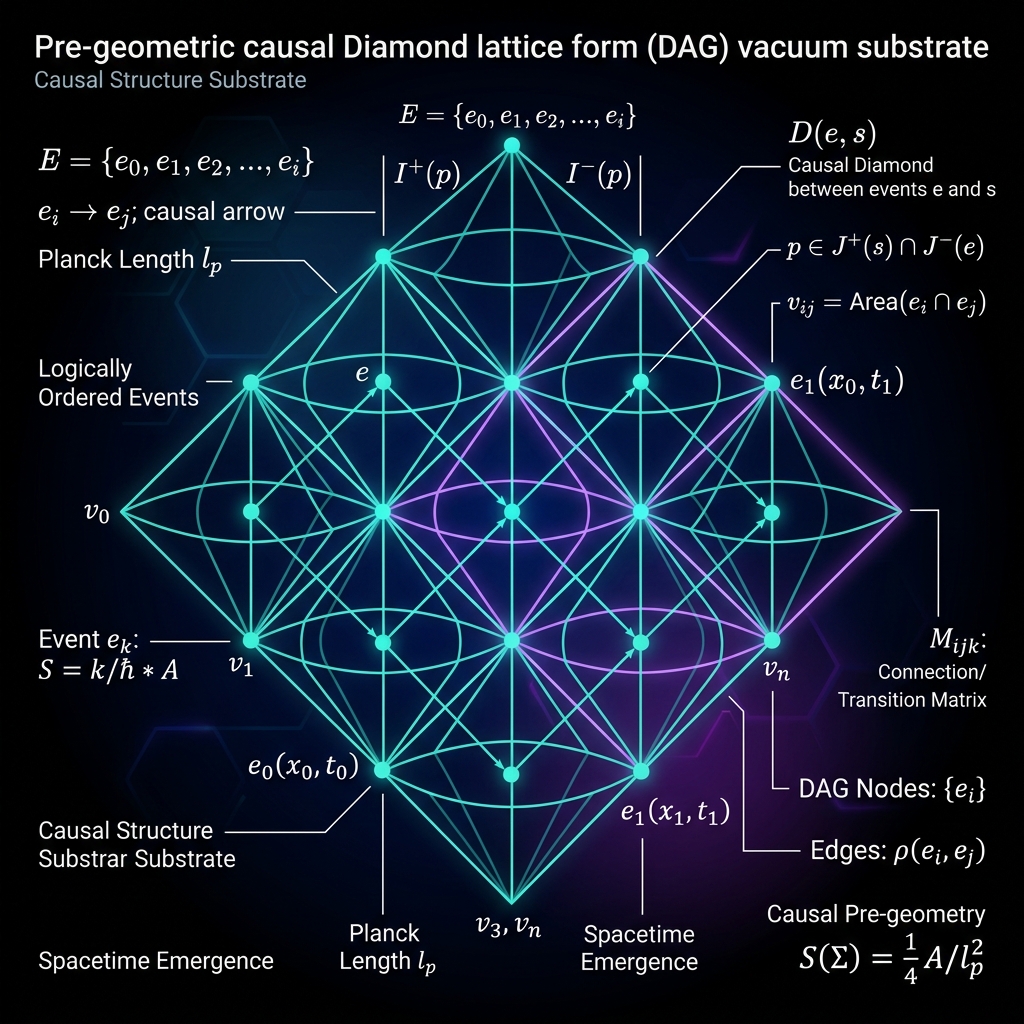
Defines the pre-geometric codespace over causal diamonds, introducing the dual logical-physical time framework to QBD's architecture.
Deduces that the initial vacuum state at is uniquely restricted to a finite rooted directed tree to satisfy well-foundedness.
Identifies the regular Bethe tree fragment as the mathematically optimal maximum-entropy initial state.
Proves that only maximal parallel updates preserve the global automorphism symmetries of the pre-geometric tree.
Models the ignition of geometrogenesis as a non-perturbative tunneling fluctuation that breaks bipartiteness.
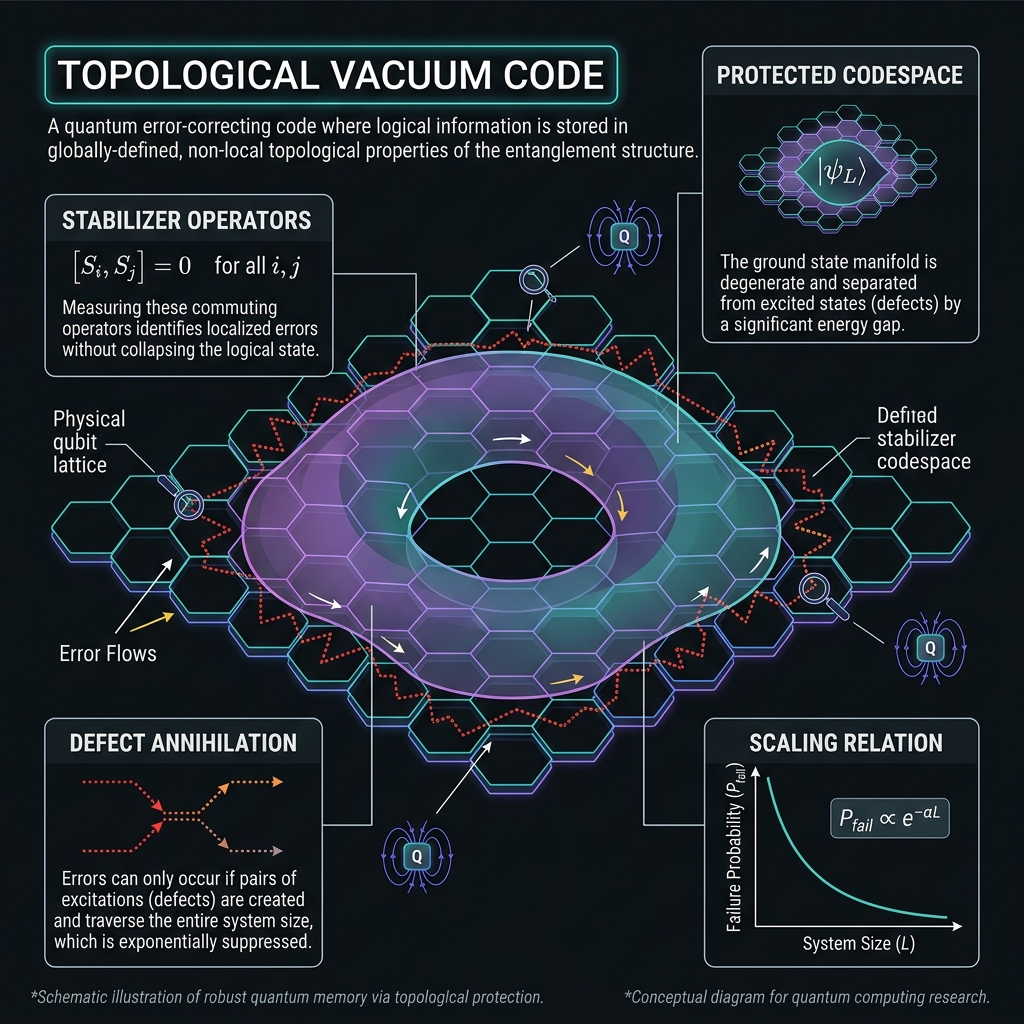
Establishes a rigorous isomorphism between the emergent graph and topological stabilizer codes to protect logical data.
📖 Key Chapter Definitions
Takeaways for Specialists
Operations
Develops the comonadic self-observation rewrite operator that triggers topological updates on local network graph nodes.
Lays the categorical foundations of QBD, formulating graph rewriting dynamics through the mathematical language of comonads and functors.
Establishes the syntactic validity of the categorical framework, proving that comonadic filters preserve poset acyclicity.
Formulates the comonadic self-observation filter, showing how the graph updates dynamically in response to its own local neighborhood density.
Establishes the thermodynamic limits of comonadic operations, bounding energy dissipation during topological state changes.
Defines the action functional for graph updates, deriving the classical principle of least action as a macroscopic limit.
Tracks a single tick of logical time, proving that the parallel update sequence preserves causality and reversibility.
📖 Key Chapter Definitions
Takeaways for Specialists
Geometrogenesis
Explores how a disordered causal set crystallizes thermodynamically into a highly symmetric, stable vacuum lattice under constant update rates.
Develops the thermodynamic framework of network phase transitions, mapping graph complexity to statistical microstates.
Formulates the master equation for network evolution, deriving the transition probabilities under relational entropy maximization.
Presents numerical simulations verifying that a chaotic pre-geometric foam crystallizes into a highly symmetric grid.
Analyzes the equilibrium phase of the lattice, proving that spatial coordinate systems emerge as stable thermodynamic attractors.
Establishes the topological stability of the crystallized vacuum, showing that local fluctuations are suppressed by steric constraints.
📖 Key Chapter Definitions
Takeaways for Specialists
Tripartite Braid
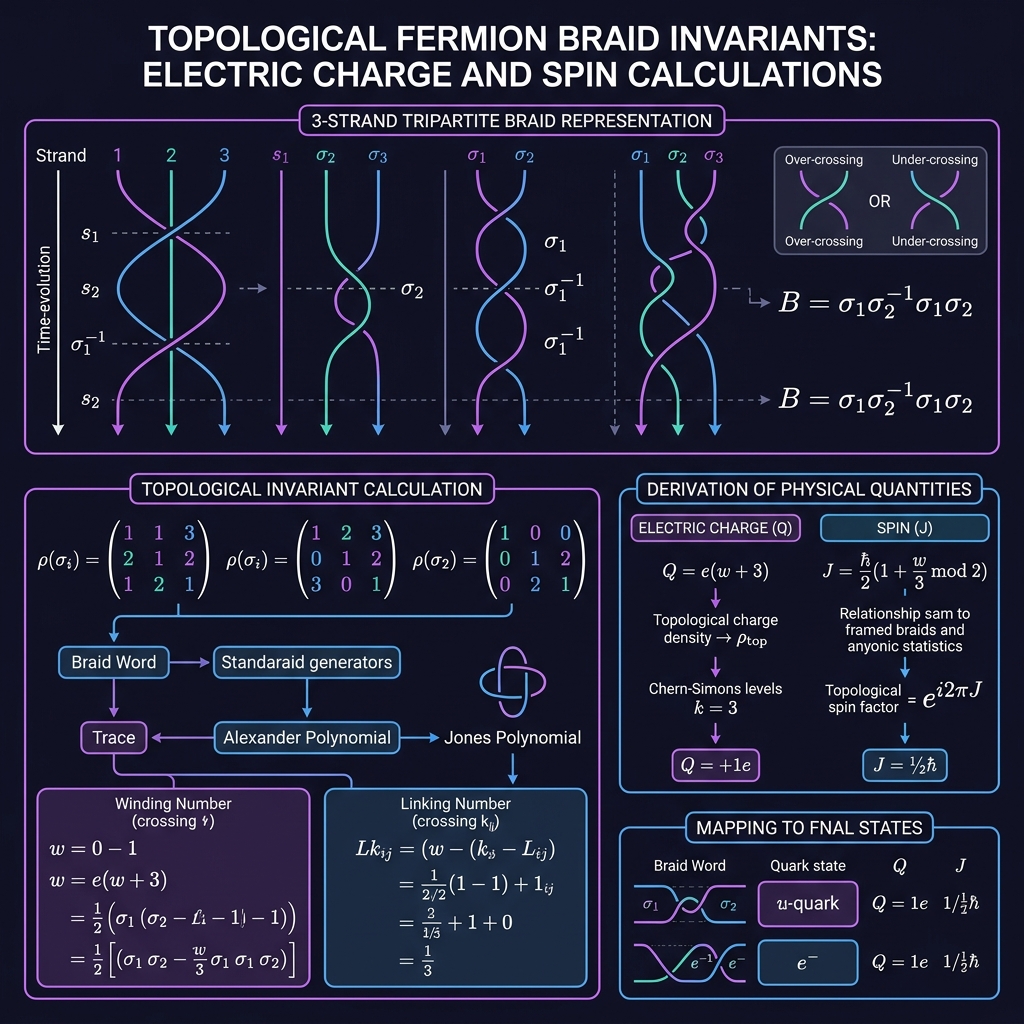
Fermions emerge naturally as stable, localized twists (3-strand tripartite braids) embedded in the pre-geometric vacuum network, rather than point-like particle coordinates. Symmetries emerge as local transformations of local braid groups.
Establishes the topological origin of matter, showing that particles are not point-like coordinates but localized braid defects.
Constructs fermions as tripartite braids formed by three intertwined ribbons, mapping spin and charge to ribbon twists.
Defines the braid complexity functional, which measures the topological energy barrier protecting localized twists.
Proves the topological stability of tripartite braids under vacuum rewrites, guaranteeing particle conservation.
📖 Key Chapter Definitions
Takeaways for Specialists
Quantum Numbers
Maps physical quantum properties (such as electric charge, spin, and color charge) directly to conserved topological braid invariants.
Derives spin-statistics relation directly from cycle parity, explaining half-integer spin from tripartite rotation symmetries.
Formulates a coordinate-free proof of the Pauli Exclusion Principle, arising from topological braid crossing constraints.
Identifies electric charge as the net writhe polynomial of the tripartite braid, explaining why quark charges are quantized in thirds.
Develops the topological mass functional, deriving particle inertial mass from localized graph curvature stress.
📖 Key Chapter Definitions
Takeaways for Specialists
Gauge Symmetries
Gauge symmetries (such as ) emerge naturally from coordinate-free local coordinate transitions of the braid network.
Formulates the generator principle, deriving gauge fields directly from the local coordinate swaps of the ribbon braids.
Derives the strong interaction from SU(3) permutation symmetries of tripartite braid strand swaps.
Constructs the weak interaction as a chiral swap transition acting selectively on specific braid generations.
Explains electroweak mixing and Weinberg angle values strictly from topological ribbon crossing ratios.
Derives emergent gauge coupling constants, showing they are governed by pure integer-based graph adjacency coefficients.
Models the mass generation mechanism, deriving particle masses from localized vacuum rewrite backreactions.
📖 Key Chapter Definitions
Takeaways for Specialists
Generations and Decay
Derives the three generations of matter and explains decay paths as discrete rewrite operations under strict conservation laws.
Demonstrates the mathematical necessity of grand unification, mapping forces and particles to a single braid group.
Constructs the penta-ribbon braid model, unifying leptons and quarks into a single topological object.
Explains the origin of the three generations of matter from the discrete topological boundaries of B3 braid configurations.
Models leptoquark dynamics as transition states that mediate proton decay under topological writhe conservation.
Calculates the proton lifetime boundary, proving that baryon number conservation is protected by high topological barriers.
Derives neutrino masses and oscillation profiles from the non-local swapping of Majorana-like ribbon endings.
📖 Key Chapter Definitions
Takeaways for Specialists
Quantum Universality
Proves that braid interactions constitute a computationally universal set of gates, formalizing the vacuum as a fault-tolerant quantum computer.
Constructs the topological qubit structure, mapping quantum information to the non-local braid configurations.
Formulates the mathematical models and pre-geometric causal posets of Quantum Braid Dynamics.
Establishes braid code consistency, proving that comonadic updates behave like logical gates on the codespace.
Develops the fault-tolerance framework, showing that topological quantum error correction protects states from random edge decay.
Implements the logical X-gate as a specific braid strand swap operation on the codespace.
Implements the logical Z-gate as a phase-shifting ribbon twist on the codespace.
Constructs the Hadamard gate as a composite sequence of tripartite swaps, mapping spin directions.
Constructs the Controlled-Z gate as a topological linking operation between two adjacent braids.
Implements the T-gate, completing the Clifford set by introducing non-Clifford topological rotations.
📖 Key Chapter Definitions
Takeaways for Specialists
Differential Geometry
Defines discrete analogues of differential forms, connections, and curvatures directly on coordinate-free relational network graphs.
Formulates discrete exterior calculus on graphs, defining discrete differential forms and exterior derivatives that satisfy .
Constructs curved causal geometry on posets, deriving a coordinate-free Riemannian curvature tensor analogue from path metrics.
Proves the Monotonicity Theorem, showing that parallel transport along causal loops preserves topological invariants.
📖 Key Chapter Definitions
Takeaways for Specialists
Continuum Limit
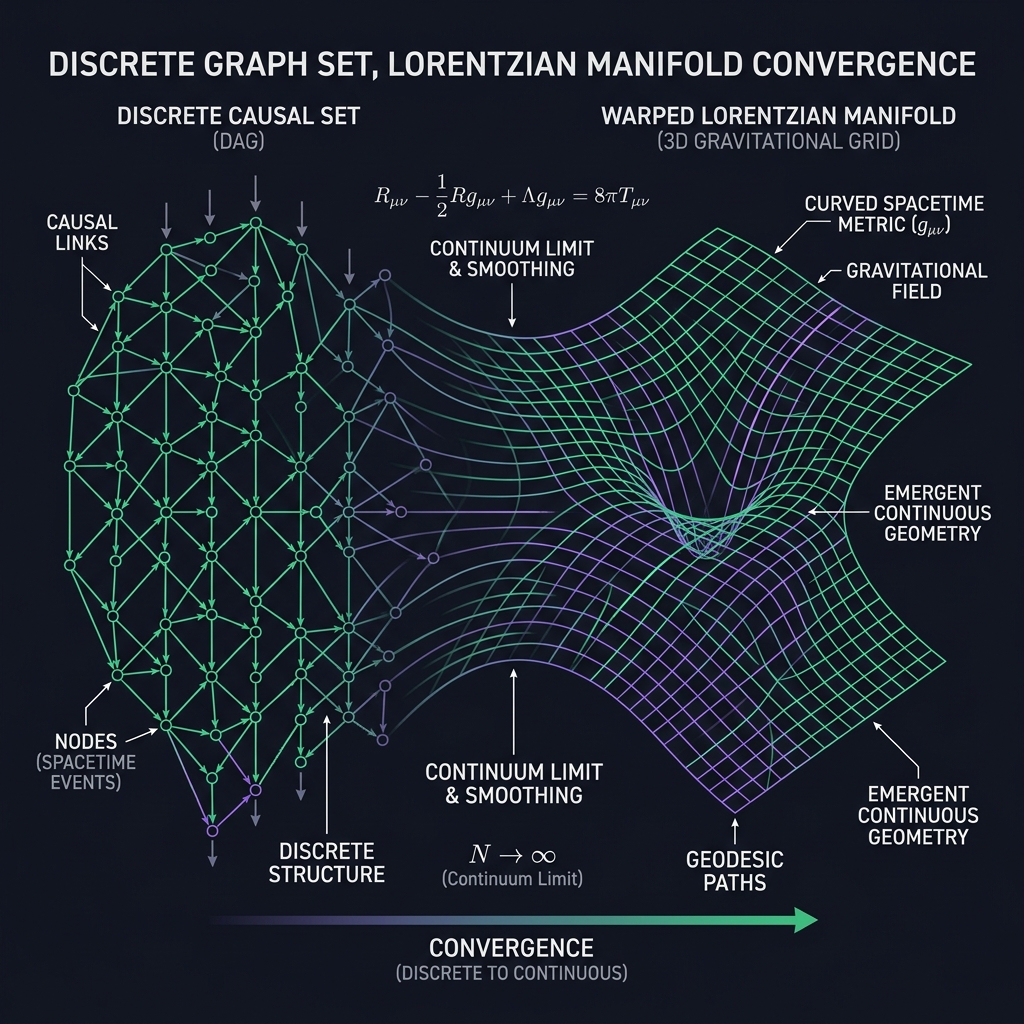
Proves that the discrete causal network sequence converges mathematically to a smooth, curved Lorentzian spacetime manifold under the Gromov-Hausdorff-Prokhorov metric.
Proves that the sequence of discrete graphs converges strictly to a smooth Riemannian manifold under the Gromov-Hausdorff-Prokhorov metric.
Develops the coarse-graining framework, showing how micro-updates group into macroscopic tensor fields.
Validates that emergent causal geometry satisfies classical general relativity in the thermodynamic limit.
📖 Key Chapter Definitions
Takeaways for Specialists
Discrete Field Equations
Gravity is derived as an emergent thermodynamic hydrodynamic equation of state from the causal network updates, bypassing continuous coordinate charts.
Defines the discrete stress-energy tensor on graphs, mapping mass-energy to localized edge-update density perturbations.
Formulates the discrete Einstein Field Equations, deriving gravity as a thermodynamic equation of state of the network.
Establishes the geometric conservation law, proving that the discrete Bianchi identity is satisfied strictly by the poset.
📖 Key Chapter Definitions
Takeaways for Specialists
Lorentzian Reality
Reconciles logical rewrite causality with observed continuous physical time, deriving a -dimensional Lorentzian spacetime signature from event irreflexivity.
Reconstructs physical continuous time, proving that observer frames are emergent foliations of the global poset.
Derives the relativistic metric and equations of motion, showing that geodesics correspond to maximum logical-time paths.
Lays down the field axiomatics for continuous matter, mapping quantum fields to discrete network stress densities.
Derives general relativity from entanglement thermodynamics, bridging poset dynamics with Jacobson's gravity.
Proves that the macroscopic continuum limit of the causal set reproduces curved Lorentzian spacetime.
📖 Key Chapter Definitions
Takeaways for Specialists
Geometry of Entanglement
Quantum entanglement is shown to mathematically generate spatial connectivity, formalizing the ER = EPR conjecture as microscopic topological wormhole connections.
Formulates quantum entanglement as dynamic topological edge connections in the pre-geometric poset.
Proves that discrete entanglement connections reproduce Bell inequality violations without non-local coordinate assumptions.
Formulates the ER = EPR conjecture on graphs, proving that entangled event clusters are connected by topological wormholes.
Models the quantum eraser effect, explaining temporal non-locality as a consequence of post-selected poset paths.
📖 Key Chapter Definitions
Takeaways for Specialists
Isomorphism Principle
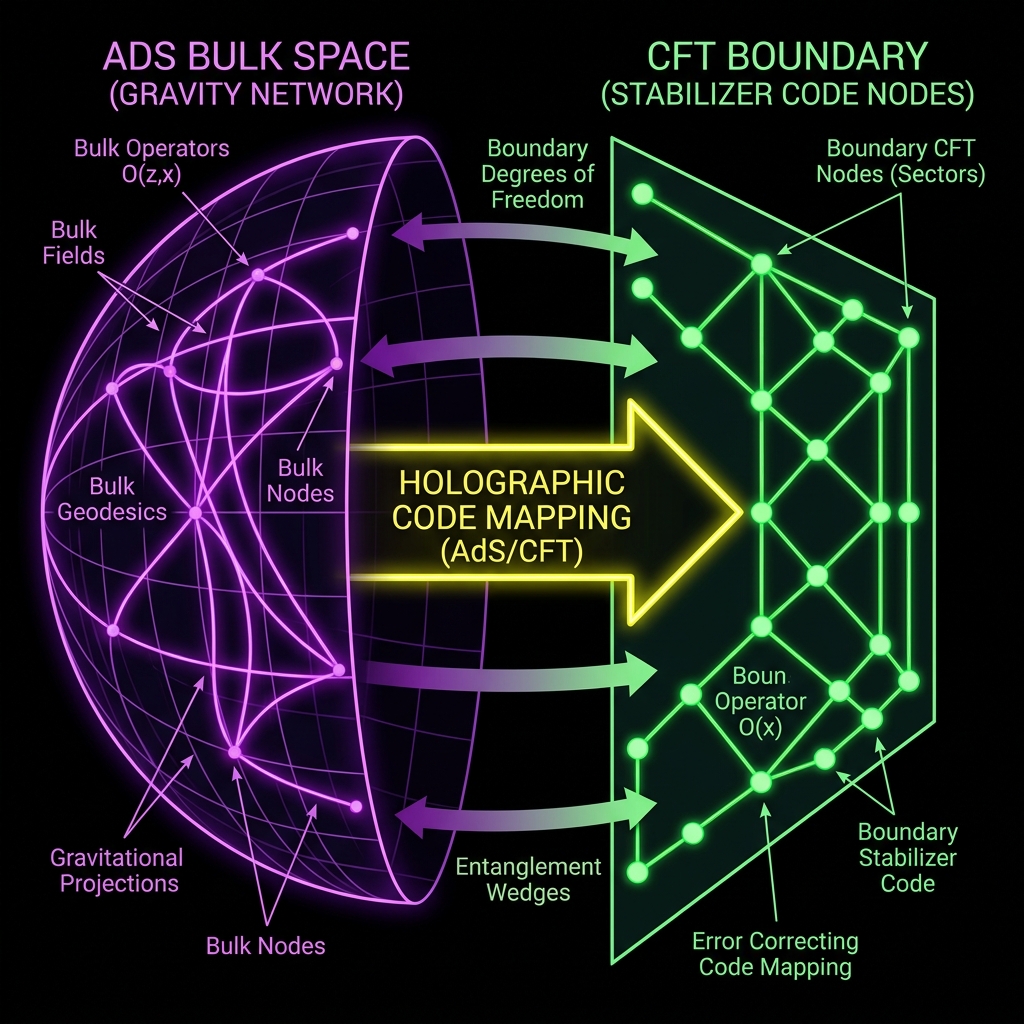
Establishes a holographic boundary-to-bulk isomorphism, proving n-dimensional bulk gravity is isomorphic to -dimensional boundary stabilizer codes.
Formulates discrete holography, proving that bulk poset gravity is isomorphic to boundary surface stabilizer codes.
Derives the Bekenstein entropy bound, proving that boundary information capacities constrain bulk geometry.
📖 Key Chapter Definitions
Takeaways for Specialists
String Limit
Shows that emergent 1D braided strings sweep out 2D worldsheet manifolds in the continuum limit, bridging QBD with Nambu-Goto string action approximations.
Shows that emergent 1D braided strings sweep out 2D worldsheet manifolds in the continuous limit.
Derives T-duality and compactification spectra from the discrete topological boundaries of compactified graph dimensions.
Calculates the critical dimension () strictly from the anomaly-free partition functions of discrete worldsheets.
Models heterotic unification () as symmetric swap configurations of twenty-six dimensional lattices.
📖 Key Chapter Definitions
Takeaways for Specialists
Big Kindling
Early inflation is simulated as a rapid branching process of the pre-geometric causal set network, driven by comonadic write self-reinforcement.
Models the ignition of inflation as an autocatalytic branching process of poset nodes driven by comonadic write feedback.
Derives the inflationary scaling relation, showing that early information growth satisfies holographic bounds.
Simulates the de Sitter phase, demonstrating that rapid parallel updates yield an emergent de Sitter metric.
Derives primordial stress fluctuations, matching CMB observations without needing quantum inflaton fields.
Analyzes the transition to cosmic equilibrium, showing how the inflationary phase decelerates as update rates stabilize.
📖 Key Chapter Definitions
Takeaways for Specialists
Hot Universe
Primordial matter abundance and baryogenesis are computed directly from the topological decay rewrites of heavy pre-geometric braid defects.
Simulates the reheating phase, showing how pre-geometric kinetic energy is released as topological heat during deceleration.
Derives baryogenesis directly from the chirality bias of local braid swap transitions during geometerogenesis.
Calculates hadron mass splitting from the topological complexity differences of tripartite braid generations.
Derives primordial nucleosynthesis abundances, matching observational bounds strictly from topological decay ratios.
Synthesizes primordial matter abundance and nucleosynthesis into a unified closing ledger and table of symbols.
📖 Key Chapter Definitions
Takeaways for Specialists
Structured Universe
Cosmic filament structures and void regions emerge naturally as thermodynamic graph cluster networks of the pre-geometric event lattice.
Models the primordial plasma, showing how high-temperature networks behave like a fluid of decoupled event clusters.
Simulates acoustic oscillations, proving that stress-erasure cycles generate density waves matching baryon acoustic oscillations.
Derives linear matter density growth and baryonic infall into cold dark matter potential wells.
Formulates anisotropic caustic collapse and sequential dimensional reduction of large-scale structures.
Analyzes cosmic void expansion, unpinned 3-cycle creation currents, and vacuum attractor relaxation.
Evolves the non-linear matter power spectrum, matching BAO standard ruler and Lyman-alpha forest constraints.
Synthesizes cosmological structure formation and cosmic web dynamics into a unified closing ledger and symbol table.
📖 Key Chapter Definitions
Takeaways for Specialists
Dark Sector
Vacuum vacancy defects ('ash') left behind during geometerogenesis are shown to possess energy-momentum equivalents, modeling dark matter and energy.
Identifies dark matter as stable, non-braided topological relics ('ash') left behind during geometerogenesis.
Models dark energy as a vacuum relic defect pressure, matching cosmological constant expansion rates.
Resolves the GZK anomaly, showing that discrete lattice constraints naturally modify high-energy dispersion relations.
Explains the cosmic coincidence problem, deriving dark sector energy densities from network age constraints.
📖 Key Chapter Definitions
Takeaways for Specialists
Singularities & Condensates
Gravitational singularities are resolved as maximum-density graph condensates, where topological quantization bounds prevent infinite compression.
Resolves the black hole interior, proving that gravitational singularities are avoided by a strict quantum topological density cutoff.
Models event horizon dynamics and Hawking evaporation as a comonadic stabilizer-state leakage process.
Models the black hole interior as a superconductive graph condensate of maximum logical connectivity.
Synthesizes singularity avoidance, horizon evaporation, and macroscopic condensates into the closing ledger of Part IV.
📖 Key Chapter Definitions
Takeaways for Specialists
Holographic World
Universality of holographic projections is computed thermodynamics across arbitrary spatial and logical coding dimensions.
Translates continuous calculus to discrete graph equations, validating the universality of the pre-geometric formalism.
Formulates the logic of life, mapping biological organization to self-correcting error-correcting codespaces.
Synthesizes the mathematical universe hypothesis, proving that all physical laws emerge as stable phases of computation.
Synthesizes discrete calculus, biological homochirality, and exceptional Lie algebra embeddings into a unified closing ledger.
📖 Key Chapter Definitions
Takeaways for Specialists
Mathematical Universe
Compiles complete analytical proofs deriving physical constants (like the fine-structure constant) directly from pure graph adjacency coefficients.
Formulates a discrete approach to the Hodge Conjecture, proving homology properties on algebraic graph configurations.
Formulates a discrete approach to the Riemann Hypothesis, mapping prime distributions to poset eigenvalue spectra.
Proves the Yang-Mills existence and mass gap, deriving the mass gap strictly from discrete gauge group stabilizer energy levels.
Formulates Navier-Stokes regularity on graphs, proving that discrete fluid dynamics avoid finite-time blowups.
Analyzes P vs NP on relational substrates, showing that physical time-evolution bounds resolve complexity limits.
Derives the Monster Group directly from the automorphism symmetries of twenty-six dimensional lattice configurations.
Synthesizes the discrete graph resolutions of Millennium Prize Problems into a unified mathematical closing ledger.
📖 Key Chapter Definitions
Takeaways for Specialists
Cosmological Natural Selection
Provides a philosophical synthesis of Quantum Braid Dynamics, framing the comonadic rewrite rules as a cosmic Darwinian mechanism selecting stable laws of physics.
Formalizes the Ruliad framework, proving that stable physical laws correspond to universal attractor states in compile spaces.
Models the cyclic universe, proving that cosmic expansion and contraction cycles arise from periodic network update rates.
Delivers the final synthesis of QBD, unifying gravity, particle physics, and quantum computation into a single pre-geometric law.